
When we think of India’s cultural heritage, vibrant festivals, sacred temples, and ancient wisdom often come to mind. But woven into this tapestry are rituals so unconventional, so shocking, that they defy mainstream understanding — practices that once shaped lives, defined honor, and sometimes blurred the lines between devotion and devastation.
From the embers of towering pyres to ceremonies whispered about in forgotten villages, these strange rites are not merely curiosities; they are echoes of a civilization wrestling with mortality, power, faith, and fear. In this documentary‑style exploration, CrypticWorld takes you beyond folklore and textbooks, into ritual spaces where history and mystery intertwine.
One such ritual — Sati, the burning of widows on their husband’s funeral pyre — continues to reverberate through India’s collective memory. Once practiced in parts of the subcontinent, it was so disturbing that laws were eventually enacted to prohibit not just the act itself, but even its glorification in cultural forms. (Wikipedia)
Recent media coverage highlights historical remnants of this practice, like the nearly 300‑year‑old Sati temple in Panzurni, Maharashtra — not as a shrine for worship, but as a historical testament to rituals long abandoned by law but still preserved in stone and legend. (The Times of India)
Meanwhile, other rites — from ancient symbolic sacrifices recounted in early Vedic texts to contemporary reports of isolated occult practices — remind us that India’s spiritual landscape has always been plural, dynamic, and, at times, unsettling.
This documentary series dissects these practices through historical evidence, eyewitness testimony, and media reports, seeking to understand not just what these rituals were, but why they emerged, and how India has grappled with them through time.
Welcome to the somber, startling, and often misunderstood world of India’s most bizarre rituals.
The Ritual of Sati — A Tragic Practice in India
Hey, have you ever heard of Sati? It’s this shocking ritual from India’s past where a widow was expected to die on her husband’s funeral pyre. Yeah… it sounds horrible, and it really was. Thankfully, it’s illegal now, but it’s still something people talk about because of the history and some modern cases.
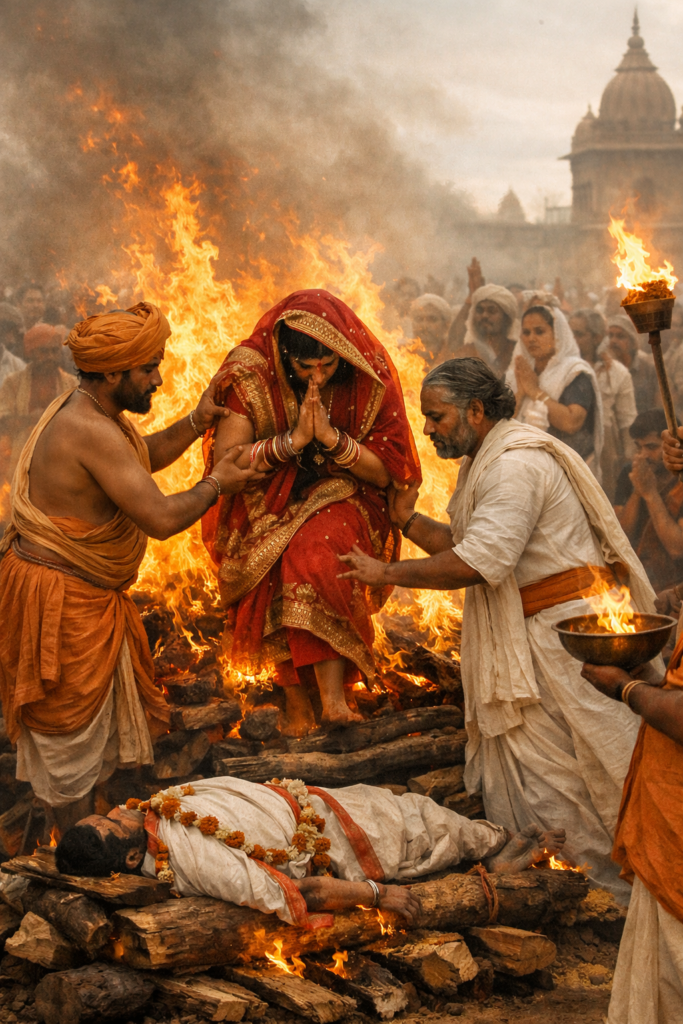
So, recently there was news about a 300-year-old Sati temple in Panzurni, Maharashtra. People aren’t talking about doing the ritual again or anything like that — it’s about preserving the temple as a part of history. You can check it out in this article: Times of India
The 1987 Roop Kanwar Case– The most famous modern example happened in 1987 in Rajasthan. An 18-year-old girl, Roop Kanwar, was burned on her husband’s funeral pyre in Deorala village. This made huge news and really shocked the country. Here’s a good report: Business Standard
After this, the government made the Commission of Sati (Prevention) Act, 1987, which not only banned the ritual itself but also made it illegal to glorify it in any way. That means no festivals, monuments, or praise for Sati.
Believe it or not, there was news just recently about this case. A court acquitted the last eight people accused in connection with the events after Roop Kanwar’s death. People had very different opinions about it, and it shows how these stories still stir up debates. Even now, in Deorala village, some people still talk about Roop Kanwar. Some see her as heroic, some see it as tragic. (Times of India)
The thing is, Sati isn’t happening anymore. What’s left is stories, temples, legal battles, and how people remember it. It’s kind of shocking to think about, but it’s also a reminder of how society has changed.
Devadasi System — What It Is and What’s Happening Today
Hey, so you might have heard the word Devadasi before, but here’s the simple version:
The Devadasi system is an old practice in India where young girls were “dedicated” to a temple and the deity there. These girls were meant to serve the temple through dance, music, and rituals, and in return, they got respect in the community.
Sounds cultural, right? But over time, it became very different from what it was originally. Many girls were forced into it, and some were even exploited sexually under the cover of tradition. That’s why the practice is banned now, but the effects still linger in some parts of the country.
What the News Says About Devadasi Today
Even today, the Devadasi system appears in the news, mostly about legal protection, rehabilitation, and social support:
- New Laws in Karnataka (2025)
The Karnataka government introduced a new law to stop any dedication of girls as Devadasis and also help rehabilitate women and children connected to the system. (Times of India) - Women Protesting for Rights
Around 500 Devadasis and women recently protested in Bengaluru, asking for better pensions, housing, and support, saying the current government aid of ₹2,000 per month is too small and often delayed. (Times of India) - Government Surveys and Rehabilitation
The government is doing new surveys to find out who needs help and make sure women get rehabilitation programs. (Bangalore Mirror) - Human Rights Attention
The National Human Rights Commission (NHRC) even sent notices to multiple states asking how they are dealing with women still affected by the Devadasi system. (NHRC) - Hopeful Stories
There are also inspiring stories — like a daughter of a former Devadasi winning four gold medals at university, proving how education and support can change lives. (Times of India)
So basically, the Devadasi system started as a cultural practice but became exploitative over time. Today, it’s illegal, but news stories show women are still fighting for rights, recognition, and support.
Human Sacrifice in India — What’s Really Happening
Alright, this is one of the weirdest and most disturbing topics — human sacrifice. You might think it’s something from ancient history, but sadly, there are modern reports in India where people have allegedly killed others believing it would bring them some supernatural benefit.
Let’s break it down simply and look at what the news has actually reported:
Scary Recent Cases From the News
- Occult Ritual Killings in Ghaziabad
Just recently, two men were arrested after they allegedly killed a friend and burned his body in an e‑rickshaw, believing it would bring them divine blessings through an occult ritual. It shocked the local community and police are still investigating. - Seven‑Year‑Old Girl Killed in Chhattisgarh
In Chhattisgarh’s Mungeli district, police arrested five relatives for allegedly abducting and killing a seven‑year‑old girl as a “human sacrifice” ritual. They told police they believed it would bring them wealth — a case that left the whole village stunned. - 9‑Year‑Old Boy in Uttar Pradesh
In Deoria, UP, four relatives were arrested after a 9‑year‑old boy was allegedly killed in an occult ritual. The accused reportedly believed a human sacrifice would cure a supposed possession.
Other Reported Ritual‑Driven Cases (Past Reports)
These aren’t current newspapers, but they have been widely reported and show the kinds of things that have happened in recent years:
- Kerala Human Sacrifice Case — Police in Kerala arrested three people after two women were allegedly tortured and murdered in the name of human sacrifice, and the case drew national media attention.
- Attack in Bengaluru Linked to Ritual — In Karnataka, a woman was attacked by her own mother with a machete in what police are investigating as possibly motivated by a human sacrifice ritual that came from astrologer advice.
- Madras High Court Comment — The Madras High Court even called it “disheartening” that human sacrifice is still happening in the 21st century, showing that India’s legal system is aware this isn’t only history.
- Law to Ban Human Sacrifice — Governments like Gujarat have told the High Court they passed laws to eradicate human sacrifice and other cruel practices, showing authorities are aware of the problem and trying to stop it.
Just to be clear, all of these are not “traditional rituals” or widely accepted cultural practices. These are crimes rooted in superstition, misunderstanding, or mental health issues, and authorities almost always treat them as murder and illegal acts.
Some of these cases even involve children being harmed, which is especially disturbing. There are no ancient scriptures that support this kind of act in modern India, and police and courts continue to act when these terrible things happen.
The Ceremony of Living Stones — What It Is and What People Believe
So, we often hear about temples and idols made from stone, right? But in some parts of India, stones themselves are treated almost like living, powerful objects — believed to have spiritual energy or protective power. That’s what we’re talking about here: people treating stones not just as objects, but as sacred things worth worshipping. It’s not a single widespread “ceremony” everywhere — it varies a lot by region — but you do see different traditions where stones play a big spiritual role.
Here are some real examples where stones are treated as sacred — some even covered by news reports:
- Sacred Stones Mistaken for Dinosaur Eggs: In a village in Madhya Pradesh’s Dhar district, people were worshipping round stones as family deities for generations — until scientists discovered they were actually fossilised dinosaur eggs. The villagers offered garlands, coconuts, and rituals around them as if these “stones” were holy figures. That was a real shock to them and made news.
- Stone‑Pelting Rituals in Himachal Pradesh:
In the ‘Pathar Mela’ (literally stone festival) near Shimla, villagers participate in a ritual stone‑pelting event during a local festival. They throw stones symbolically, and the blood of a wounded participant may be marked as sacred tilak at a temple — a custom tied to old sacrificial traditions. This was covered in news in 2025. - Sacred Stones Believed to Cause Energy Changes: In Turakapalem village, Andhra Pradesh, people believed that corner stones placed incorrectly changed spiritual energy and were linked to sickness and deaths — so much so that villagers were afraid to go outside at night. Officials were still investigating whether the deaths were medical or spiritual.
- Rituals Around Stones in Other Places:
Some temples have stones that devotees treat as especially powerful — for example, at Barai Mata Temple in Madhya Pradesh, pebbles from ancient stones are believed by some to have healing properties for smallpox (reported in local news).
Why Do People Treat Stones This Way?
You might wonder why stones get so much respect. Here are some common reasons people believe stones are “alive” spiritually:
👉 Stones are unchanging and ancient — people feel they connect deeply to history or ancestors.
👉 In many faiths, stones represent gods or sacred symbols. For instance, the Shiva Lingam — a stone symbol of Lord Shiva — is worshipped widely in Hinduism.
👉 Some stones are tied to local legends or miracles (like protecting a village or bringing good luck).
👉 In some tribal and folk beliefs, stones are seen as spiritual guardians or living spirits.
So, when people do rituals for stones — whether offering flowers, tying threads, placing them at village corners, or including them in festivals — it’s really about respecting what they believe is spiritual presence, not just worshipping a rock.
This idea still appears in lots of different ways:
Pilgrimages and festivals include stone‑based rituals. Local beliefs link stones with protection or luck. News stories occasionally highlight strange or misunderstood stone practices — like dinosaur fossils becoming sacred stones. Disagreements and controversies happen when beliefs clash with science or public perception — like the Andhra Pradesh village story.
At the end of the day, this isn’t one “official ritual” with rules — it’s a category of beliefs and customs where stones are treated as living, powerful, or spiritually significant objects in people’s lives.